
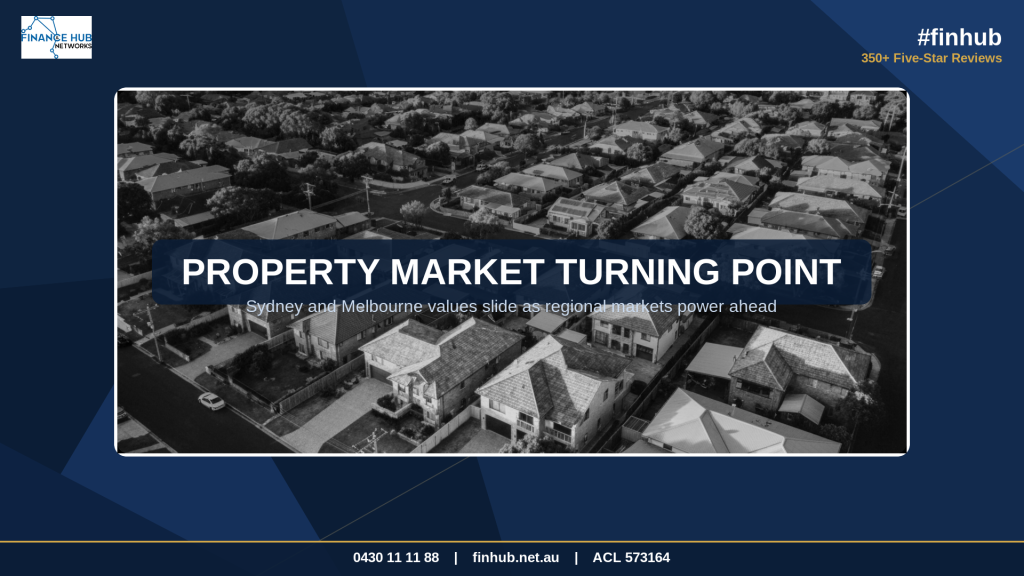
Sydney and Melbourne Property Values Fall: What It Means for Australian Home Buyers in 2026
Meta description: Sydney and Melbourne home values are falling while regional markets surge. Here’s what the April 2026 property data means for buyers, investors and refinancers in Australia.
If you’ve been watching the property market closely, April 2026 delivered a reality check that many economists had been forecasting. National dwelling values barely moved — rising just 0.3 per cent according to Cotality’s national home value index — the weakest monthly result since January 2025. But the headline figure only tells part of the story. Beneath it lies a market that is splitting sharply along geographic and price-tier lines, creating both risks and opportunities depending on where you’re buying, selling or refinancing.
Sydney and Melbourne: The Cool Change Arrives
Australia’s two largest property markets both recorded falls in April 2026. Sydney home values dropped 0.6 per cent over the month and are now sitting 0.9 per cent lower over the quarter — approximately 1 per cent below their November 2025 peak. Melbourne has fared worse, with values down 0.6 per cent for the month, 1.5 per cent over the quarter, and 1.9 per cent below their own November 2025 high.
These are not dramatic crashes, but they represent a meaningful reversal for homeowners who purchased near the peak. PropTrack’s data reinforces this picture, recording a 0.5 per cent fall in Sydney and 0.3 per cent in Melbourne for April — the first national monthly price decline of 2026, with the median dwelling value nationally now sitting at $910,000, and $1,017,000 across the combined capitals.
Cotality research director Tim Lawless described the environment bluntly: “Sentiment has fallen off a cliff, and rising inflation is set to drive the cost of debt even higher.” He also noted the cooling had been building since late 2025, well before the latest round of rate increases. The combination of high interest rates, stretched affordability and weakening consumer confidence is creating genuine pressure for borrowers with large mortgages in these markets.
A Two-Speed Market: Where Prices Are Still Growing
Not every city is experiencing the same headwinds. Perth remains the standout performer — dwelling values climbed 2.1 per cent in April alone and 6.8 per cent over the quarter, though some signs of moderation are beginning to appear. Brisbane, Adelaide and Darwin also recorded solid monthly gains of 1.2, 1.1 and 1.3 per cent respectively, supported by relative affordability and steady population growth.
Regional markets across Australia continue to outperform the capitals. Cotality’s combined regional index rose 4.2 per cent over the first four months of 2026, compared with just 1.8 per cent for the combined capitals over the same period. Standout performers include Western Australia’s Bunbury (up 9.8 per cent) and Queensland’s Darling Downs–Maranoa (up 7.9 per cent). PropTrack reported that regional dwelling values are now 54.4 per cent higher over five years, compared with 35.8 per cent for the capitals.
This divergence matters enormously for buyers considering their options. A dollar stretches considerably further in regional Queensland or regional WA than in Sydney’s inner suburbs — and current data suggests those regional markets are still seeing genuine demand driven by internal migration and lifestyle factors.
The Impact of Higher Rates — And What’s Coming
A critical driver of the current market slowdown is the interest rate environment. The Reserve Bank of Australia (RBA) has raised rates multiple times since early 2026, and Westpac’s chief economist Luci Ellis has reaffirmed a forecast that the RBA will lift the cash rate again at its May meeting — from 4.10 per cent to 4.35 per cent — with further increases anticipated in June and August, potentially taking the cash rate as high as 4.85 per cent.
This matters directly to anyone with a variable-rate home loan. Higher cash rates translate quickly into higher mortgage repayments. For a borrower with a $700,000 loan, each 0.25 per cent rate increase adds roughly $85–$105 per month to repayments. With three further rises potentially ahead, the cumulative impact could be substantial.
It’s important to note that market forecasts involve uncertainty. Westpac itself has noted the outlook beyond May depends significantly on how quickly higher energy costs flow through to non-fuel prices including food and building materials. Economic conditions can shift, and interest rate decisions are always made in the context of the full range of data available at the time.
Important: If you have a home loan at a variable rate, you should review your current rate and repayment capacity. Your full financial situation would need to be reviewed prior to acceptance of any offer or product.
What This Means for First Home Buyers
For first home buyers, the falling values in Sydney and Melbourne may appear to offer an entry opportunity — but the picture is nuanced. Affordability pressures haven’t disappeared just because prices have retreated slightly from their peaks. The median dwelling price in Sydney still sits well above $1 million, and servicing a mortgage at current interest rates requires a significantly higher income than it did two years ago.
What is notable in the data is that price growth is increasingly concentrated in the lower-priced segments. Cotality noted that in Sydney, lower-tier house values are up 2.9 per cent year-to-date while the most expensive quarter of the market has fallen 3.3 per cent. This suggests there is still genuine demand for more affordable properties, even as premium segments soften.
For those exploring entry into the market, understanding your borrowing capacity, deposit requirements, and the government schemes available to you (such as the Home Guarantee Scheme) is critical. A mortgage broker can help you understand what is realistically available across the 35+ lenders on our panel — including lenders who may not be widely advertised to the public.
What Should Existing Homeowners Do?
If you already own a property in Sydney or Melbourne, a modest decline in values doesn’t necessarily require immediate action. However, if you’re on a variable rate and your repayments are climbing, now is an excellent time to review your loan structure.
Questions worth exploring with a broker include:
- Is my current interest rate competitive given today’s market conditions?
- Would fixing part or all of my loan provide greater certainty over the next 12–24 months?
- Am I making use of available loan features such as offset accounts or redraw facilities?
- Does my loan structure still suit my financial goals?
Refinancing is not always the right answer for every borrower — exit fees, break costs on fixed loans, and the time required to process a new application all need to be factored in. But in many cases, reviewing your current loan can identify meaningful savings or a structure that better suits your current needs.
Outlook: Cautious Optimism With Eyes Open
The April 2026 data confirms that Australia’s property market is in transition. The surge in values seen in late 2024 and early 2025 has given way to a more complex landscape where geography, price tier, and interest rate sensitivity all play significant roles in outcomes.
For buyers, the key is preparation: understanding your financial position clearly before entering a market where both prices and borrowing costs are in motion. For existing owners, this environment rewards those who are proactive about reviewing their loan structure rather than waiting for conditions to change.
As always, individual circumstances vary enormously. General market commentary should be considered alongside professional advice tailored to your specific financial situation.
Frequently Asked Questions
Are Sydney and Melbourne property prices going to keep falling in 2026?
Based on April 2026 data from Cotality and PropTrack, Sydney and Melbourne dwelling values have declined modestly — each down around 0.6 per cent for the month. Whether this continues depends on a range of factors including future RBA rate decisions, inflation outcomes, and consumer confidence. Market forecasts involve uncertainty, and individual outcomes will vary based on property type and location. We recommend reviewing your personal financial position with a qualified mortgage broker rather than making decisions based on general market trends alone.
Should I buy property now or wait?
There is no universal answer to this question — the right time to buy depends on your financial situation, goals, deposit size, borrowing capacity and the specific market you’re considering. What we can say is that being well-prepared matters significantly: understanding what you can borrow, which government schemes you may qualify for, and which lenders offer terms suited to your circumstances are all steps worth taking before the market shifts again. Your full financial situation would need to be reviewed prior to acceptance of any offer or product.
How do rising interest rates affect my home loan repayments?
If you have a variable-rate home loan, your repayments will rise when the RBA increases the cash rate — typically within weeks of the RBA decision. For a $700,000 loan, a 0.25 per cent rate increase adds roughly $85–$105 per month to repayments. If Westpac’s forecasts of three further rate increases prove correct, that could mean an additional $250–$300 per month for the same loan size. A mortgage broker can help you explore whether refinancing or fixing your rate would be beneficial given your individual circumstances.
Contact Daniel Nguyen at FinHub for a no-obligation consultation:
📞 1300 346 482 | 🌐 finhub.net.au | ✉️ daniel@finhub.net.au
FinHub — Award-finalist brokers with 350+ Five-Star Google Reviews, $600M+ in loans settled, and 35+ lenders on panel.
Australian Credit Licence 573164 — Finance Hub & Networks Pty Ltd
Your full financial situation would need to be reviewed prior to acceptance of any offer or product.
This article is for educational and informational purposes only and does not constitute financial advice. Interest rate forecasts are provided by third-party economists and may not eventuate. Past market performance is not a reliable indicator of future results.
Hashtags: #finhub #australianproperty #homeloan #mortgagebroker #sydneyproperty #melbourneproperty #propertynews #interestrates #firsthomebuyer #refinancing #australianrealestate
