
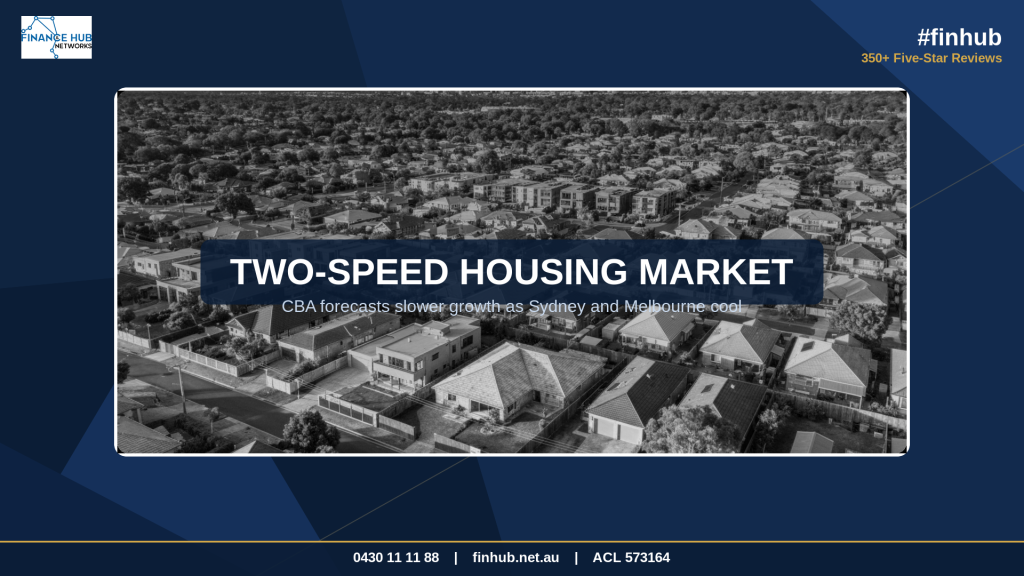
Australia’s Two-Speed Housing Market: CBA Forecasts Slower Price Growth Ahead
Australia’s national dwelling prices have surged nearly 10% over the past year, sitting roughly 55% above pre-COVID levels. But according to Commonwealth Bank senior economist Trent Saunders, the era of rapid growth may be cooling — with higher interest rates expected to slow national house price growth to around 5% this year and just 3% in 2027.
For mortgage holders and prospective buyers across Australia, this shift signals a changing landscape that’s worth understanding — especially if you’re considering purchasing, refinancing, or reviewing your current loan structure.
What Is a Two-Speed Housing Market?
The term “two-speed market” describes the growing divide between Australia’s capital cities. While Perth, Brisbane, and Adelaide continue to record strong price growth — with Perth outpacing the national average by more than 40% since the pandemic began — Sydney and Melbourne are telling a different story.
According to Cotality Australia data, home values in Sydney and Melbourne have been shrinking since February 2026 and are now in mild negative territory. Construction in these cities has actually outpaced population growth, which has contributed to softer conditions.
In contrast, the mid-sized capitals benefit from tighter supply and robust underlying demand. As CBA’s Saunders noted: “For markets like Perth, Brisbane, and Adelaide, fundamentals remain strong. We expect growth to slow, not reverse.”
What’s Driving the Slowdown in Sydney and Melbourne?
Several factors are weighing on Australia’s two largest property markets:
- Higher interest rates: The RBA’s rate decisions continue to impact borrowing capacity across the board. Each rate increase reduces how much buyers can borrow, placing downward pressure on prices in already-expensive markets.
- Rising fuel costs: Surging petrol prices linked to global instability are adding to household cost-of-living pressures, making buyers more cautious.
- Affordability constraints: In Sydney, activity has shifted toward the more affordable end of the market, where budget pressures are most acute.
- Auction clearance rates: Preliminary clearance rates have fallen below 60% for three consecutive weeks — well below the March quarter average of 68.1%. In Sydney, 26.7% of auctions were withdrawn from sale.
It’s important to note that while these factors are creating headwinds, CBA does not forecast a national price decline. The overall market remains in positive territory thanks to strong performance in smaller capitals.
The Supply Challenge Remains
At the heart of Australia’s ongoing affordability challenge is a persistent shortfall in housing supply. The National Housing Accord targets 1.2 million new homes over five years to June 2029, but construction continues to fall short of that goal.
While demand-side measures like the 5% Deposit Scheme provide near-term support for some buyers, economists broadly agree that lasting affordability improvement requires supply-side reform. As Saunders put it: “There’s widespread recognition that supply reform is where the bigger gains will come from.”
What This Means for Borrowers
Whether you’re a first home buyer, an investor, or a homeowner considering refinancing, a shifting market means it’s more important than ever to understand your options:
- Buyers in Sydney and Melbourne may find slightly improved conditions, but borrowing capacity constraints remain a challenge in a higher-rate environment.
- Buyers in Perth, Brisbane, and Adelaide face a still-competitive market, though growth is expected to moderate from recent highs.
- Existing homeowners should consider reviewing their current loan to ensure it still suits their circumstances — particularly if they haven’t reviewed their rate in the past 12 months.
Every borrower’s situation is different, and what works for one person may not work for another. Exploring your options with a qualified mortgage broker can help you understand how market changes affect your specific circumstances.
FAQ: Australia’s Two-Speed Housing Market
What does a two-speed housing market mean for Australian home buyers?
A two-speed housing market means different cities are performing very differently. Perth, Brisbane, and Adelaide are seeing continued price growth driven by strong demand and limited supply, while Sydney and Melbourne are experiencing mild price declines. Buyers should research conditions in their specific market rather than relying on national averages.
Will Australian house prices fall in 2026?
According to Commonwealth Bank forecasts, national dwelling prices are expected to grow around 5% in 2026 before slowing to 3% in 2027. However, individual city performance varies significantly. Sydney and Melbourne values have already moved into mild negative territory, while other capitals continue to grow. A broad national decline is not currently forecast.
How do interest rate changes affect my borrowing power?
When interest rates rise, lenders assess your ability to repay at a higher rate, which typically reduces the maximum amount you can borrow. This is one reason why higher rates tend to slow property price growth. Speaking with a mortgage broker can help you understand your current borrowing capacity based on the latest lender policies and your financial situation.
Should I refinance my home loan in a changing market?
Market shifts can create opportunities to review your loan structure. If you haven’t compared your current rate against what’s available from 35+ lenders recently, it may be worth exploring whether a more competitive option exists for your situation. A no-obligation consultation with a broker can help you assess your options without any commitment.
Is now a good time to buy property in Australia?
Timing the market is difficult and depends entirely on your personal financial situation, goals, and the specific location you’re considering. Rather than trying to predict market movements, it’s generally more helpful to focus on whether a purchase fits your budget and long-term plans. A mortgage broker can help you understand what you can comfortably afford.
Explore Your Options with FinHub
Whether you’re buying your first home, refinancing, or investing, Finance Hub & Networks (FinHub) can help you navigate the current market. With access to 35+ lenders and 350+ five-star Google reviews, our award-finalist brokers are here to help you explore your options.
Contact Daniel Nguyen at FinHub — 📞 1300 346 482 | 🌐 finhub.net.au
Finance Hub & Networks Pty Ltd — Australian Credit Licence 573164. Your full financial situation would need to be reviewed prior to acceptance of any offer or product.
#finhub #mortgagebroker #australianproperty #housingmarket #homeloans #sydneyproperty #melbourneproperty #refinancing #firsthomebuyer #propertymarket #interestrates