Westpac Warns of Three More Rate Hikes — What Australian Borrowers Need to Know
Finance Hub & Networks (FinHub), a licensed mortgage brokerage in Sydney, Australia (ACL 573164), breaks down Westpac’s latest interest rate forecast and what it could mean for Australian homeowners, investors, and first home buyers in 2026.
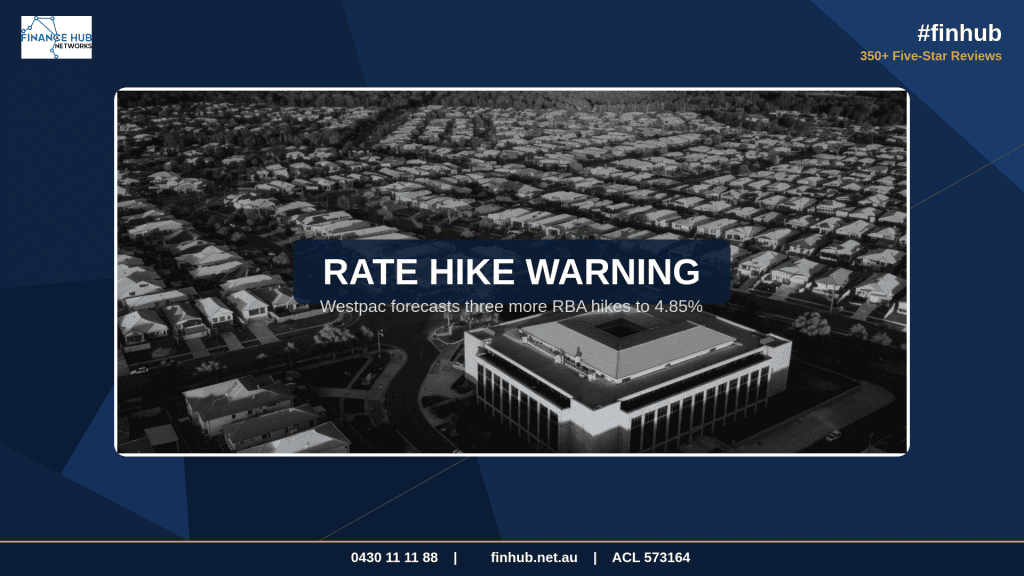
In a stark warning that has sent ripples through the Australian mortgage market, Westpac’s chief economist Luci Ellis has doubled down on the bank’s forecast of three more rapid-fire RBA rate hikes — potentially pushing the cash rate to 4.85% by August 2026. The message was blunt: “The economy does not care about your feelings.”
Why Is Westpac Forecasting More Rate Rises?
The driver behind this forecast is the ongoing energy supply shock linked to Middle East conflict. Unlike the supply chain disruptions during COVID or the redistribution of Russian oil and gas, the current situation involves a direct cut to global production — an estimated 8–9 million barrels of oil per day lost, compared to just 3 million during the peak of the Russia-Ukraine conflict.
According to Westpac, higher fuel and input costs are filtering through to broader Australian prices faster than expected. Building materials have seen the sharpest impact, with the cost of a detached home estimated to have risen by as much as 10%. Many businesses have lifted list prices more permanently, making reversals unlikely even if oil prices ease.
For the Reserve Bank of Australia, this adds another leg to already-elevated underlying inflation — and that makes further rate increases more probable.
What Does This Mean for Australian Mortgage Holders?
If Westpac’s forecast plays out with three 25-basis-point hikes in May, June, and August, repayments on a typical $600,000 variable rate home loan could increase by approximately $270–$300 per month. That’s on top of the increases borrowers have already absorbed since the current tightening cycle began.
It’s important to note that forecasts are just that — predictions, not certainties. Other economists hold different views, and the RBA’s actual decisions will depend on incoming data around inflation, employment, and global conditions. A lasting ceasefire in the Middle East, for example, could ease inflationary pressures and alter the rate path.
Signs of Strain Are Already Emerging
Roy Morgan estimates that 24.9% of mortgage holders — approximately 1.32 million Australians — were at risk of mortgage stress in February 2026. If rates rise further, that figure could climb to 30.3%, or around 1.6 million borrowers.
On the positive side, Australia’s LNG export capacity has shielded the country from the extreme energy shortages experienced in other nations. Unemployment, while rising to 4.3%, remains below historical stress thresholds. And distressed property listings are still near record lows in most capital cities.
However, economists caution that distressed listing data typically lags reality by 12–24 months. The fact that forced sales are low today doesn’t necessarily reflect what’s happening in household budgets right now.
What Can Borrowers Do Right Now?
While no one can predict exactly where rates will land, there are steps mortgage holders and prospective buyers can take to prepare:
- Review your current loan: If you haven’t compared your rate recently, your lender’s standard variable rate may be significantly higher than what’s available elsewhere. A mortgage broker can help you compare options across 35+ lenders.
- Stress-test your repayments: Use online calculators to model what your repayments would look like if rates rise by another 0.50% or 0.75%. Understanding your buffer is critical.
- Consider your loan structure: Some borrowers are exploring options like splitting between fixed and variable rates to manage risk. Each approach carries its own trade-offs, so it’s worth discussing with a qualified broker.
- Protect your savings buffer: Financial experts suggest maintaining at least 3–6 months of repayments in accessible savings as a safety net.
- Seek professional guidance: Everyone’s financial situation is different. Speaking with a licensed mortgage broker can help you explore your options based on your specific circumstances.
A Balanced Outlook
It’s worth noting that Westpac’s forecast represents one view among many. Ellis herself acknowledged that if the ceasefire holds and global energy supply stabilises, “downside risks to growth diminish and inflation risks ease.” In that scenario, the rate path could look very different.
For borrowers, the key takeaway is not to panic — but to be prepared. Understanding where you stand, knowing your options, and having a plan can make a significant difference in navigating an uncertain interest rate environment.
Frequently Asked Questions
How many more interest rate rises does Westpac predict in 2026?
Westpac’s chief economist forecasts three additional 25-basis-point RBA cash rate increases in May, June, and August 2026, which would bring the cash rate to 4.85%. However, this is one forecast among many, and the actual path will depend on inflation data, employment figures, and global developments including the Middle East situation.
How much could my mortgage repayments increase if rates rise again?
Each 0.25% increase typically adds approximately $90–$100 per month to repayments on a $600,000 variable rate home loan. If three hikes occur as Westpac predicts, that could mean an additional $270–$300 per month. Individual impacts vary based on loan size, type, and lender — a mortgage broker can help you model your specific scenario.
Should I fix my home loan rate to protect against rate rises?
Fixing your rate can provide repayment certainty, but it comes with trade-offs — fixed rates may not always be lower than variable rates, and you may face break costs if you need to refinance or sell. Whether fixing is suitable depends on your individual financial situation, goals, and risk tolerance. It’s worth exploring your options with a qualified mortgage professional.
What is mortgage stress and how many Australians are affected?
Mortgage stress generally refers to a situation where a household is spending a significant portion of income on home loan repayments, leaving limited room for other expenses. Roy Morgan estimates approximately 1.32 million Australian mortgage holders (24.9%) were at risk of mortgage stress in February 2026, with that number potentially rising to 1.6 million if rates increase further.
Can a mortgage broker help me manage rising interest rates?
A licensed mortgage broker can review your current loan, compare options across multiple lenders, and help you explore strategies suited to your financial situation — whether that’s refinancing, restructuring, or simply understanding where you stand. At FinHub, we compare options from 35+ lenders at no obligation to you.
Explore Your Options with FinHub
If you’re concerned about rising interest rates or want to review your current home loan, the team at Finance Hub & Networks (FinHub) can help you explore your options. With 350+ five-star Google reviews, $600M+ in loans settled, and access to 35+ lenders, we’re here to provide personalised assistance tailored to your needs.
Contact Daniel Nguyen at FinHub
📞 1300 346 482 | 📱 0430 11 11 88
📧 daniel@finhub.net.au
🌐 finhub.net.au
Finance Hub & Networks Pty Ltd — Australian Credit Licence 573164.
Your full financial situation would need to be reviewed prior to acceptance of any offer or product. This article is for educational purposes only and does not constitute financial advice. Interest rate forecasts referenced are from third-party sources and may not eventuate. Both potential benefits and risks of any financial decision should be carefully considered.
#finhub #mortgagebroker #interestrates #RBA #homeloan #australianproperty #mortgagestress #refinancing #westpac #sydneymortgagebroker #propertymarket #homebuyers