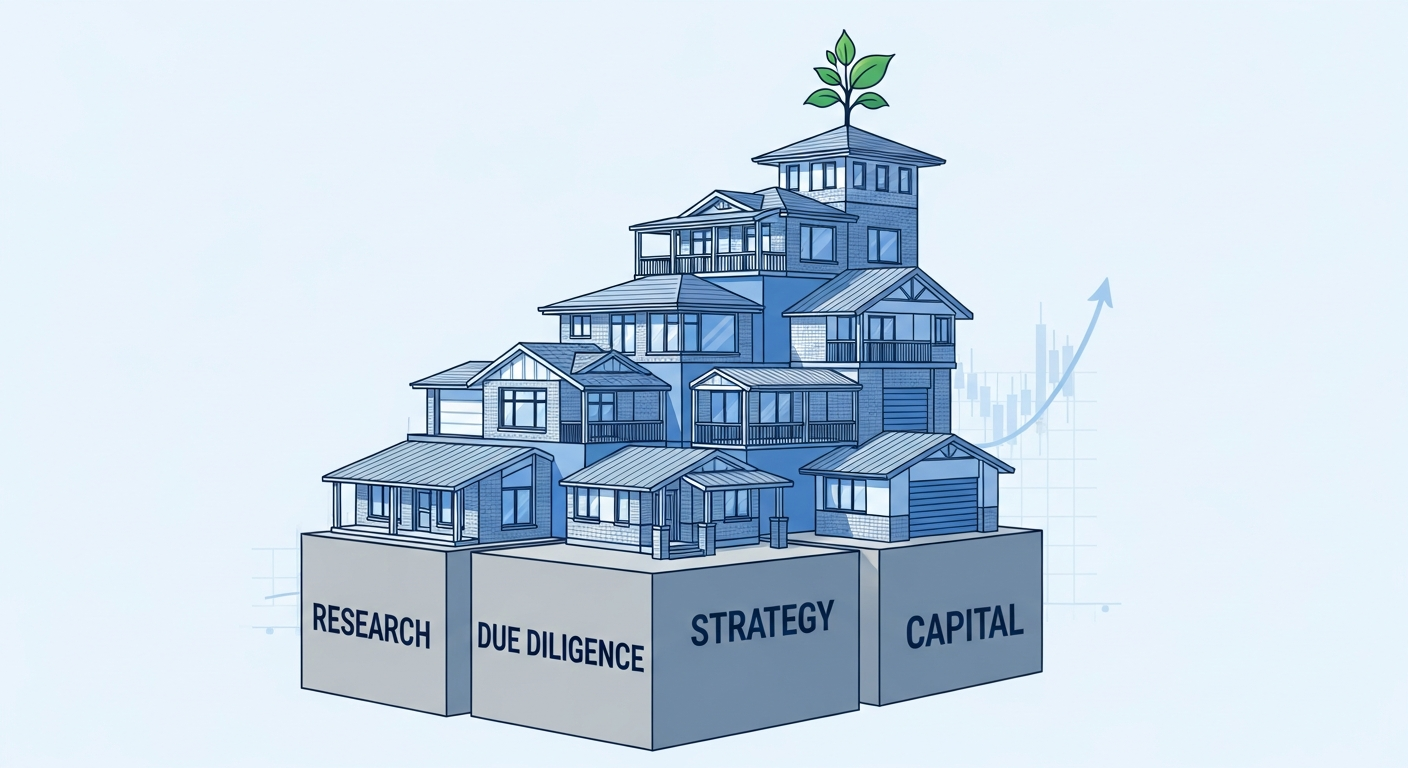
Are you using your home equity to buy investment properties? You might be putting your entire portfolio at risk without even knowing it. Discover why thousands of property investors are restructuring their loans — and how you can protect your family home.
A simple explanation of one of the biggest hidden risks in property investing — and how it could affect your family home.
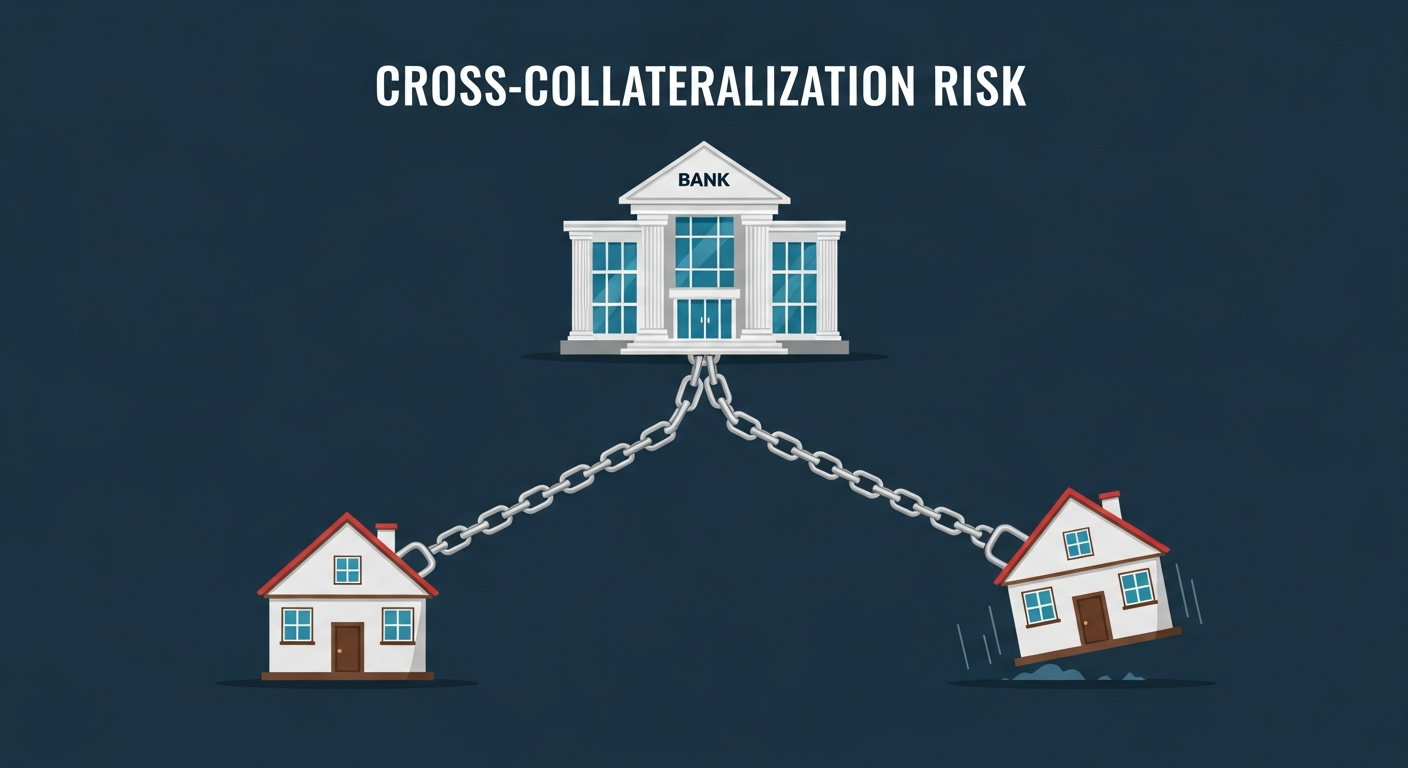
Cross-collateralisation is when a bank uses multiple properties as security for one or more loans, linking them together in a way that ties your entire portfolio's fate to every single property.
In plain terms: if you default on one loan, the bank can sell any of your linked properties to recover the debt — including your family home — even if that property has nothing to do with the defaulted loan.
💡 Think of it like tying all your boats together — if one sinks, it pulls the others down too.
It sounds dramatic, but it happens more often than you'd think. And most borrowers don't even realise their properties are cross-collateralised until they try to sell, refinance, or — worst case — can't make a repayment.
⚠️ Banks love cross-collateralisation because it gives them MORE control over your assets. If you default on one property, they can sell ANY of your properties to recover the debt.
Understanding the motivation behind why bank lenders set up your loans this way — and why it's not always in your best interest.
Banks design their lending policies to protect their risk first. Cross-collateralisation gives the bank maximum security over your assets — more properties securing loans means less risk for them, regardless of the impact on you.
Bank lenders work for the bank — they follow their employer's policies. They might not even explain the risks of cross-collateralisation. Not because they're bad people, but because their job is to follow bank policy and process your application.
Cross-collateralisation gives the bank more security and gives you less flexibility. It makes it extremely difficult to refinance, sell individual properties, or move to a competing lender — effectively locking you in.
Banks make it easy: "Use your home equity! Borrow 100% with no savings needed!" It sounds amazing — but the catch is they secure the new loan against all your properties. Convenience today becomes a trap tomorrow.
"They might not want to, but that is their employer's policy. A bank lender is there to protect their employer — the bank — not to protect you. That's why independent advice matters."
— The Finance Hub Approach
Every property investor needs to understand these risks before allowing a bank to link their properties together.
When your properties are cross-collateralised, the bank has security over all of them. If you fall behind on repayments and the bank needs to recover the debt, they choose which property to sell — not you. You also lose flexibility when selling, as the bank must approve the release of any linked security.
If you want to sell one property but the other linked property has dropped in value, the bank will require you to reduce the remaining loan to 80% of the current (lower) value. This means more of your sale proceeds go toward covering the shortfall — leaving you with less money for your next purchase or other goals.
Want better interest rates? Good luck. Untangling cross-collateralised properties is complex, time-consuming, and expensive. Banks know this — that's exactly why they structure your loans this way. You're effectively locked in.
Want to sell just one property? The bank must revalue all your linked properties. If any property has dropped in value, you may need to pay down the loan from your sale proceeds to meet the bank's LVR requirements. A straightforward sale can turn into a complex process of revaluations, negotiations, and unexpected costs.
Your equity is locked up across multiple properties. You can't access it freely to invest, renovate, or respond to life changes. The bank controls when and how your equity can be used — limiting your financial freedom.
One bad investment can bring down your entire portfolio — like dominoes. Because all properties are linked, a problem with a single property doesn't stay contained. It spreads to every linked property in your portfolio.
See exactly how these two approaches compare — and why standalone structures protect property investors.
| Factor | ❌ Cross-Collateral | ✅ Standalone Structure |
|---|---|---|
| Control | Bank controls all properties | You control each property independently |
| Selling | Must revalue everything | Sell any property freely |
| Refinancing | Extremely difficult | Refinance any loan independently |
| Default Risk | All properties at risk | Only the specific property at risk |
| Flexibility | Locked in with one lender | Use different lenders for best rates |
| Exit Strategy | Complex and costly | Clean and simple |
How to still borrow 100% from the bank — without putting your family home at risk.
🚫 Never use your home equity as security to borrow 100% of an investment property. There is a smarter way.
Use your first home to borrow just enough for the 20% deposit + purchase costs of the investment property. This is set up as a separate loan split secured by your home.
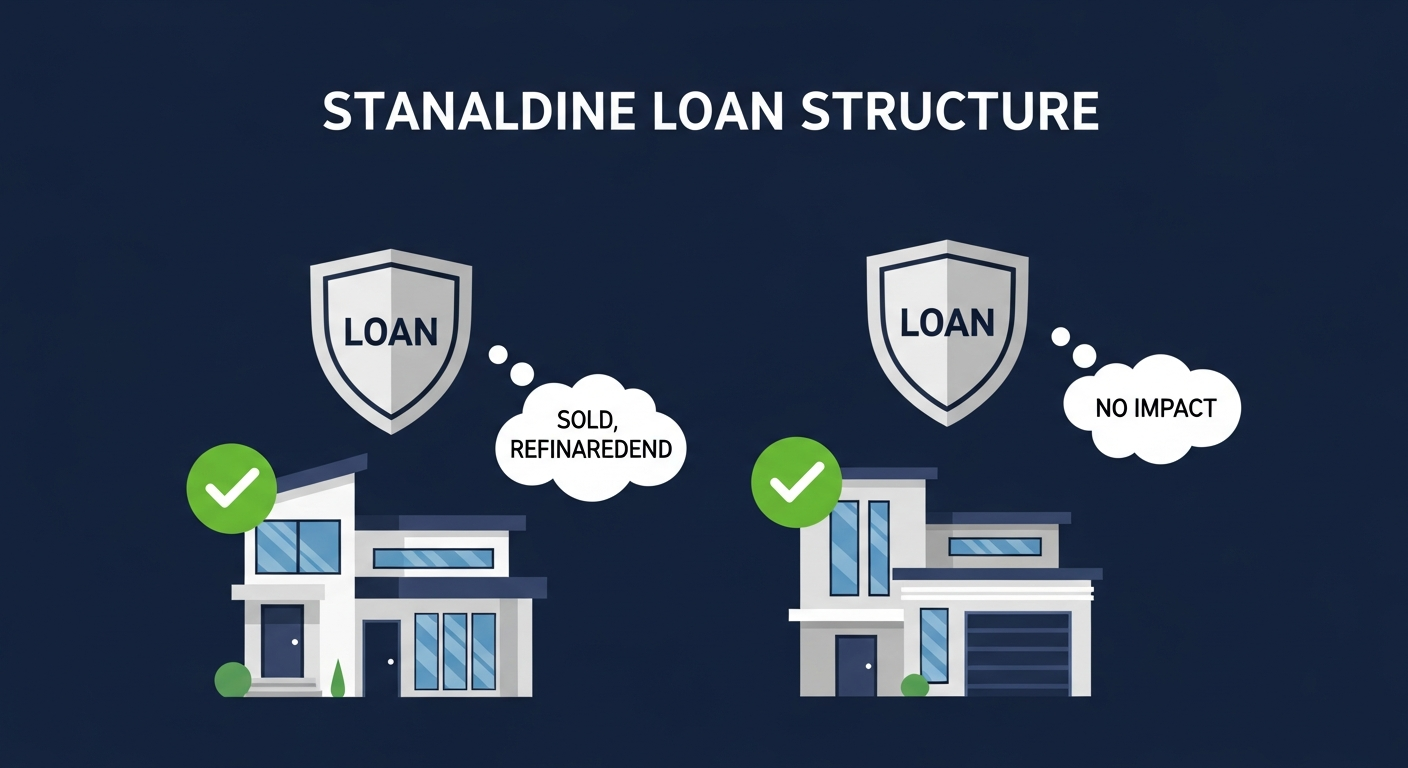
Get a completely separate loan secured ONLY by the investment property for 80% LVR. This loan stands on its own — your home is not linked to it at all.
You still effectively borrow 100% from the bank, BUT your home only secures a small equity release — NOT the full investment. Each property stands independently.
See how the same financial situation plays out very differently depending on loan structure.
Sarah owns a home worth $800,000 (owes $400,000).
Her bank says: "Use your home equity! We'll lend you $650,000 for an investment property using both properties as security."
Result: Both properties are chained together. When Sarah wants to refinance for better rates 2 years later, the bank won't release either property. She's stuck paying higher interest on everything. The "easy" option at the start has now cost her tens of thousands in trapped interest payments.
Mark owns a home worth $800,000 (owes $400,000).
His broker says: "Let's set up a separate equity release of $160,000 (20% of $650,000 purchase + $30,000 costs) secured by your home. Then a NEW separate loan of $520,000 (80% LVR) secured only by the investment property."
Result: Mark's home loan is $560,000 total. The investment has its own $520,000 loan. Two years later, Mark refinances the investment loan to a better rate — no issues at all. His home is completely safe and untouched by the investment loan.
Both Sarah and Mark used their owner-occupied home as security to borrow 100% of the investment property value. A few years later, the investment property drops in value — and now they want to sell their home. Here's how it plays out:
Because her home and investment are tied together under one security structure, when she sells her home the bank reassesses the entire portfolio. Her investment property is now worth less than what she paid. The bank requires her investment loan to be reduced to 80% of the current (lower) property value — meaning Sarah must use a larger portion of her home sale proceeds to pay down the investment loan shortfall, leaving her with significantly less money for her next home.
His home loan is completely separate from his investment loan. When he sells his home, the sale proceeds go entirely toward paying off only his home loan. His investment property — even though it has dropped in value — is on its own standalone loan. As long as he continues making repayments, the bank has no reason to intervene. Mark keeps full control of his sale proceeds and his next move.
Important note: Banks do not force borrowers to sell properties simply because values drop — as long as you continue meeting your repayment obligations. The real risk with cross-collateralisation is the financial shortfall when you want to sell one property and the linked property has fallen in value.
A solid structure is the key to success and protects you when things don't go as planned.
"Building a property portfolio is like building a house — a solid structure is the key to success and protects you when things don't go as planned."
One of the most common misconceptions about property investment structuring — and the truth confirmed by the ATO.
"If I borrow against my home, I can't claim tax deductions on the investment loan."
The ATO determines tax deductibility based on the PURPOSE of the borrowed funds — NOT which property secures the loan.
Important: Always consult your accountant for personalised tax advice. This is general information only and should not be relied upon as specific tax advice for your situation.
No obligation, no pressure — just clear, honest advice about your loan structure.
Tell us about your current properties, loans, and goals. We need to understand your full picture — not just one loan. Fill out the form below or book a call.
We review your entire portfolio structure, identify any cross-collateral risks, and recommend the optimal standalone approach. We'll show you the numbers so you can see the difference.
No obligation, no pressure. We explain everything clearly so you can make an informed decision. If you're happy, we manage the entire restructure from start to finish.
"A bank lender is there to protect their employer. They might not want to, but that is their employer's policy. We are here to protect YOU."
Whether you suspect your properties are cross-collateralised, or you're planning to buy your next investment property, we'll review your entire loan structure and show you the optimal approach — at no cost.
We've received your details and will be in touch within 1 business day. In the meantime, feel free to book a time that suits you below.
Choose a time that suits you for a free, no-obligation portfolio structure review.
Everything you need to know about cross-collateralisation and standalone loan structures.
📋 Explore More
We offer 25+ home loan and finance solutions for every situation, profession, and lending challenge.
Browse All Services →