
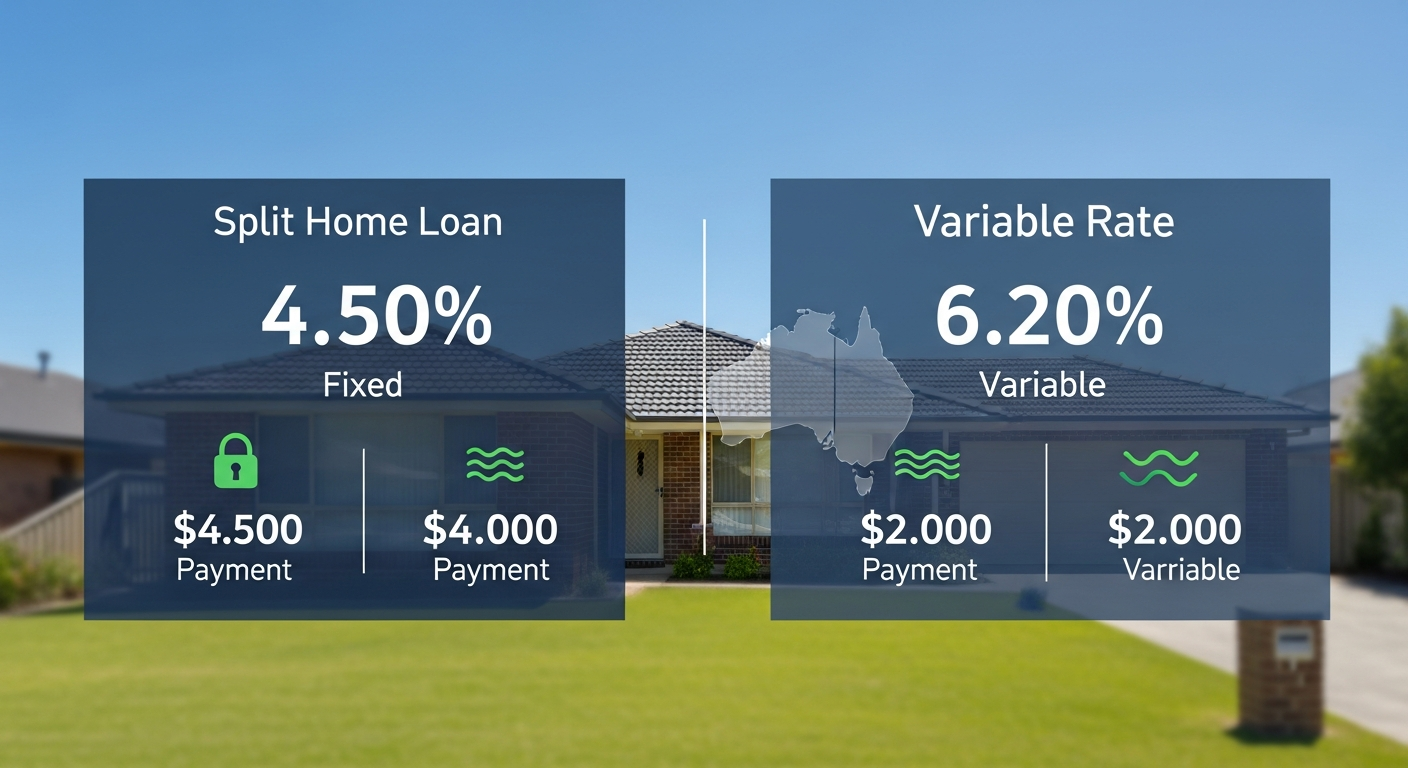
A split loan divides your mortgage into a fixed-rate portion and a variable-rate portion — giving you the certainty of fixed repayments with the flexibility and features of variable. It's the balanced approach smart borrowers love.
It's the question every borrower faces: do you lock in a fixed rate for certainty, or go variable for flexibility? Both options have genuine advantages — and real drawbacks. Most borrowers agonise over this decision because the stakes feel high and the future is unpredictable.
The truth is, neither option is universally better. What matters is finding the right balance for your financial situation, goals, and comfort level.
Choosing between fixed and variable is one of the hardest decisions borrowers face:

We structure split loans that balance certainty and flexibility based on your financial position, goals, and risk appetite. We advise on the optimal split ratio and help you choose the right fixed term length.
See how a split loan gives you features from both worlds:
| Feature | 100% Fixed | 100% Variable | Split Loan |
|---|---|---|---|
| Rate Certainty | ✓ Full certainty | ✗ Rate changes with market | ✓ Partial certainty on fixed portion |
| Offset Account | ✗ Not available (most lenders) | ✓ Full offset benefit | ✓ Offset on variable portion |
| Extra Repayments | ✗ Limited ($5-10K/yr) | ✓ Unlimited | ✓ Unlimited on variable portion |
| Redraw Facility | ✗ Not available | ✓ Full redraw access | ✓ Redraw on variable portion |
| Rate Rise Protection | ✓ Fully protected | ✗ Fully exposed | Partially protected (fixed portion) |
| Break Costs | ✗ Potentially high | ✓ No break costs | Only on fixed portion if broken |

A split loan isn't for everyone — but for many borrowers, it's the smartest way to structure a mortgage. Here are four common situations where splitting delivers real value:
Fix a portion for budget certainty on your first mortgage, while keeping the variable portion for offset and extra repayments as your income grows.
Worried about rate rises but don't want to give up offset and flexibility entirely. Splitting lets you hedge your bets and sleep easier at night.
You have significant savings earning offset benefit. Keep those attached to the variable portion while fixing the rest for certainty.
Coming off a fixed rate? Split your new loan to lock in current fixed rates on part while maintaining variable flexibility on the rest.
Use our quick loan assessor to get an estimate of your borrowing power — then we'll model your split loan options.
Try the Loan AssessorOur four-step process ensures your split loan is tailored to your financial goals and optimised across our panel of 30+ lenders.
We review your income, expenses, savings, and risk tolerance to recommend the optimal fixed/variable split ratio for your situation.
We advise on how much to fix (50/50, 60/40, 70/30) and the fixed term length (1-5 years) based on market conditions and your plans.
We compare split loan offerings across 30+ lenders — rates, features, offset availability, and extra repayment allowances on the fixed portion.
We ensure the variable portion has full offset and redraw, while the fixed portion provides the repayment certainty you need.

Get the most out of your split loan with these practical strategies from our experienced mortgage brokers:
Your offset account only works on the variable portion. If you have $50K in savings, keeping at least $50K on variable ensures your offset benefit is fully utilised.
Shorter fixed terms (1-2 years) give you certainty without locking you in too long. Reassess and re-split when the fixed period expires.
Some lenders allow multiple loan splits — e.g., one variable, one 2-year fixed, one 3-year fixed. This 'laddering' strategy provides staggered certainty.
When your fixed portion expires, it typically reverts to a higher standard variable rate. Contact us before expiry to renegotiate or re-split.
Explore other loan solutions that complement a split loan strategy: