🏛️ Specialist Trust Lending Brokers

Buying Property Through a Trust? Most Lenders Make It Harder Than It Needs to Be.

Trust borrowers face restrictive LVR caps, no LMI availability, trust deed certification costs, and lenders that won't count your real income. With 30+ lenders on our panel, we find the one that actually understands your trust structure — and says yes.

4.9/5 Google Rating
353+ 5-Star Reviews
30+ Lenders
$600M+ Settled
$0 Cost to You
Trust home loan specialist reviewing trust documents with clients

Does This Sound Like You?

Trust borrowers face unique challenges that most lenders — and most brokers — simply don't understand.

"

"My accountant set up a family trust for asset protection, but now no lender will go above 80% LVR. I need a 20% deposit for a $1.2M property — that's $240,000!"

"

"I've been told I can't get Lenders Mortgage Insurance because the loan is in a trust name. Why does borrowing through a trust disqualify me from LMI?"

"

"The bank wants the trust deed certified by their panel solicitor at MY cost — on top of all the other legal fees. The certification alone costs $500–$1,500."

"

"My accountant distributes profits through the trust, but the lender only counts what's on my personal tax return. My trust earns $300K but I can only borrow based on $120K distribution."

"

"The bank declined my trust loan because it's a hybrid trust. I didn't even know there were trust types that lenders won't accept."

"

"Every director of my trustee company needs to personally guarantee the loan. My business partner doesn't want to be a guarantor — now what?"

What Is a Trust Home Loan?

Understanding how trusts work — and why lenders treat them differently — is the first step to getting approved.

A Trust Is a Relationship, Not an Entity

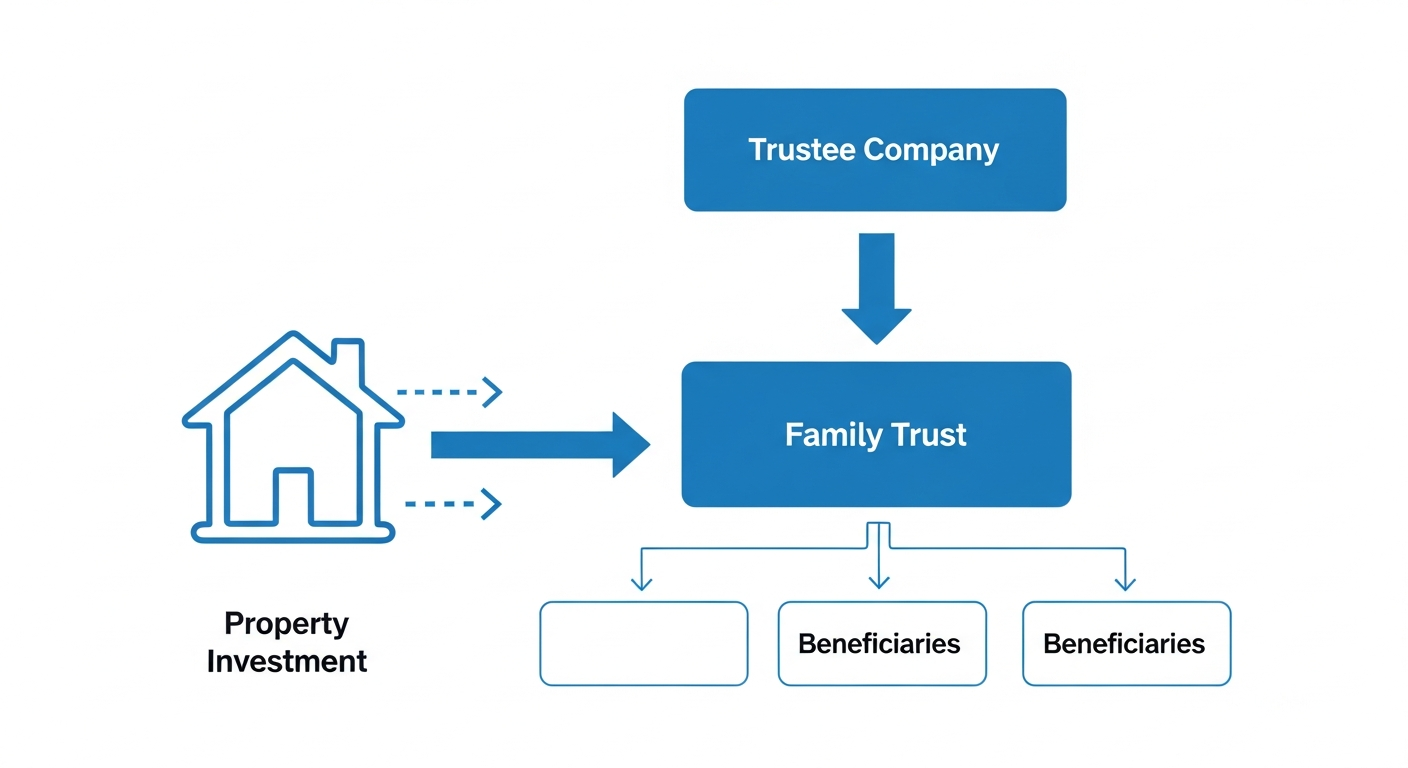
A trust is a legal arrangement where one party (the trustee) holds and manages assets on behalf of others (the beneficiaries). Unlike a company, a trust is not a separate legal entity — it's a relationship governed by a trust deed.

When you borrow through a trust, the trustee is the legal borrower and the registered owner of the property. But because the trust itself has no legal standing to sue or be sued, lenders require personal guarantees from the individuals behind the structure.
Why People Use Trusts for Property

  • 🛡️ Asset Protection — Trust assets are generally protected from personal creditors and legal claims
  • 💰 Tax Planning — Distribute rental income to lower-tax beneficiaries (e.g., adult children or spouse)
  • 📋 Estate Planning — Trusts allow orderly transfer of assets without probate complications
  • 🏢 Business Separation — Keep investment properties separate from personal and business liabilities
Trust structure diagram showing trustee, beneficiaries, and trust deed relationships

Types of Trusts & Lender Acceptance

Discretionary / Family Trust

The most common trust type. The trustee has full discretion over how income and assets are distributed to beneficiaries. Accepted by most lenders.

Unit Trust

Beneficiaries hold fixed units (like shares) with predetermined entitlements. Common for joint ventures and multiple investors. Accepted by many lenders.

Hybrid Trust

A mix of discretionary and unit trust features. The combination of variable and fixed entitlements creates uncertainty. Most lenders reject hybrid trusts outright.

Bare Trust

Only used for holding property on behalf of a Self-Managed Super Fund (SMSF). Not used for standard residential lending.

Testamentary Trust

Created by a will and comes into effect after death. Generally not accepted for lending purposes.

How Lenders Assess Trust Borrowers

Not all assessment methods are equal. The right approach can dramatically change your borrowing power.

Approach A

Trust Distribution Income

Uses trust distributions shown on your individual tax return. The most common method for established trusts with consistent distribution history.

  • 2 years individual tax returns + Notices of Assessment
  • 2 years trust tax returns + financial statements
  • Addbacks available: depreciation, interest, amortisation
  • Distributions must be consistent year-on-year
  • Most lenders require minimum 2-year history
✨ Best for: Established trusts with consistent annual distributions
Approach B

Salaried Self-Employed (Trust)

If you pay yourself a regular PAYG salary from the trustee company, some lenders will assess you like an employee — dramatically simplifying the process.

  • Recent payslips showing regular PAYG salary
  • Evidence the trust/company is profitable
  • Maximum 80% LVR applies
  • Minimum 18 months ABN/ACN registration
  • No need for full trust financial analysis
✨ Best for: Directors paying themselves a regular PAYG salary from trustee company
Approach C

Full Financial Assessment

Comprehensive analysis of the trust's complete financial position. Takes more documentation but unlocks the highest borrowing power.

  • Full 2 years trust financials + individual returns
  • Can include: distributions, addbacks, undistributed profit
  • Undistributed profit counted with min 25% ownership
  • Maximum borrowing power available
  • Complex structures supported
✨ Best for: Complex structures wanting maximum borrowing capacity
Approach D

Alt Doc / Low Doc Trust

For trusts with irregular or difficult-to-document income, select non-bank lenders offer alternative documentation pathways.

  • Income self-certification + accountant declaration
  • BAS statements (6–12 months)
  • Available from select non-bank lenders
  • Typically max 70–80% LVR
  • Higher interest rates than full doc
✨ Best for: Trusts with irregular or hard-to-document income

Assessment Approach Comparison

Side-by-side comparison to help you identify the best path forward

Feature A: Distribution Income B: Salaried Self-Employed C: Full Financial D: Alt Doc
Documentation LevelModerateLowHighLow
Income AssessedTrust distributions on personal returnPAYG salary from trust/companyDistributions + addbacks + undistributed profitSelf-declared / BAS
Max LVR80%80%80%70–80%
LMI Available✗ Generally No✗ Generally No✗ Generally No✗ No
Min Trading History2 years18 months2 years6–12 months
Borrowing PowerModerateLimited to salaryHighestModerate
Processing SpeedStandardFasterSlowerStandard
Lender AvailabilityMost major lendersSelect lendersMost major lendersNon-bank lenders
Ideal CandidateEstablished trusts, consistent distributionsDirectors on regular PAYG salaryComplex structures, max borrowingNew trusts, irregular income

Key Lender Requirements for Trust Loans

Trust lending involves specific requirements beyond standard home loans. Here's what you need to know.

📋 Trust Deed Certification

Lenders require the trust deed to be reviewed and certified before approving the loan:

  • Under $200K — Self-declaration by borrower may be accepted
  • $200K to $3M — Solicitor's certificate required (borrower's solicitor)
  • Over $3M — Panel solicitor certification required (lender's choice)
  • Costs range from $500 to $1,500+ depending on complexity

🔒 Personal Guarantees

Because a trust has no legal personality of its own:

  • All directors of the trustee company must provide unconditional joint and several personal guarantees
  • Individual trustees must also personally guarantee
  • Guarantors' personal assets may be at risk
  • All guarantors must be party to the loan contract

📊 LVR & LMI Restrictions

Trust loans face stricter lending thresholds:

  • Maximum 80% LVR for most trust borrowers
  • LMI (Lenders Mortgage Insurance) is generally NOT available for trust borrowers
  • This means a minimum 20% deposit is required
  • Some non-bank lenders may offer slightly higher LVR on case-by-case basis

🏢 ABN/ACN & GSA Requirements

Business registration and security agreements:

  • Minimum 18 months to 2 years ABN/ACN registration required
  • General Security Agreement (GSA) over trust assets may be required
  • Trust must be established and stamped (where applicable) before application
  • Trustee company must be solvent and active

⚖️ Acceptable vs Rejected Trust Types

Not all trusts are treated equally by lenders:

  • Accepted: Discretionary/Family trusts, Unit trusts
  • Rejected: Hybrid trusts, Bare trusts, Testamentary trusts
  • Trust deed must not contain unusual or restrictive clauses
  • Trust must have clearly defined beneficiaries

📍 State-by-State Requirements

Trust requirements vary by Australian state:

  • Trust on Title: QLD allows trust name on title; other states require "Trustee for [Trust Name]" wording
  • Stamping Required: NSW, NT, TAS, VIC — trust deed must be stamped before settlement
  • No Stamping Required: ACT, QLD, SA, WA — no stamp duty on trust deed establishment
  • Always confirm state-specific requirements before lodging

Real Trust Loan Scenarios We've Solved

Every trust situation is unique. Here's how we've helped borrowers just like you get approved.

1

The Property Investor

Situation:Family trust earning $250K in distributions. Wanted to purchase an investment property.
Problem:First lender only counted $120K showing on the personal tax return as salary — ignoring trust income entirely.

Solution:We used Approach C (Full Financial Assessment) with addbacks for depreciation and interest. Income assessed at $210K+.
Approved — $890K loan at 80% LVR with full borrowing power
2

The Director on Salary

Situation:Director paying himself $180K PAYG salary from trustee company. Trust was profitable but with complex multi-entity financials.
Problem:Multiple lenders wanted full trust financial analysis — delaying the application by months.

Solution:We used Approach B (Salaried Self-Employed). Only needed payslips + proof of trust profitability. No full financial analysis required.
Approved — $720K loan in 3 weeks without full trust financials
3

The Hybrid Trust Rejection

Situation:Client applied for a trust loan using their hybrid trust. Didn't realise this trust type was problematic.
Problem:Declined by 3 major lenders in succession. Each cited "unacceptable trust structure" as the reason.

Solution:We worked with their accountant to restructure to a standard family trust, then matched with a lender accepting the new structure.
Approved — After restructure, secured $650K loan at competitive rate
4

The Alt Doc Trust

Situation:Newly established trust with only 1 year of financials. Distributions were irregular across the first 12 months.
Problem:No lender would accept 1-year financials. Standard 2-year requirement was a dead end.

Solution:We used Approach D (Alt Doc) with a non-bank lender — BAS statements + accountant's income declaration.
Approved — $480K loan at 70% LVR via non-bank alt doc pathway

Trust Loan Eligibility Estimator

Get a quick estimate of your borrowing power, likely LVR cap, and what documents you'll need.

🏛️ Trust Home Loan Calculator

Answer a few quick questions to see your indicative borrowing position

Est. Borrowing Power
Likely Max LVR
LMI Available?
Min Deposit Required

📄 Documents You'll Likely Need

    ⚠️ This is an indicative estimate only. Actual borrowing power depends on full financial assessment. Get a free personalised assessment →

    Why Trust Borrowers Choose Finance Hub

    We don't just process loans — we specialise in complex trust lending that other brokers can't handle.

    • 🏛️

      Trust Lending Specialists

      We understand the nuances of discretionary trusts, unit trusts, hybrid trusts and company trustee structures — inside and out.

    • 🔍

      We Know Which Lenders Accept Your Trust

      With 30+ lenders on our panel, we know exactly which lenders accept your specific trust type and structure — saving you weeks of rejections.

    • 📋

      We Handle the Trust Deed Certification

      We manage the entire trust deed certification process, liaise with solicitors, and ensure your deed meets lender requirements before lodging.

    • 💰

      Maximise Your Borrowing Power

      We structure your application using the assessment method that gives you the highest borrowing capacity — not just the easiest to process.

    • 🆓

      $0 Cost — We're Paid by the Lender

      Our service costs you nothing. The lender pays our commission when your loan settles. That's it.

    • 353+ Five-Star Google Reviews

      Don't take our word for it — read what hundreds of trust borrowers and property investors say about working with us.

    Finance Hub trust lending specialist helping clients with property finance

    Your Trust Loan — Approved in 3 Steps

    We make the complex simple. Here's how it works.

    1

    Share Your Trust Structure & Financials

    Tell us about your trust type, trustee structure, income, and property goals. We'll identify the best assessment pathway from day one.

    2

    We Match You to the Right Lender & Method

    Using our 30+ lender panel, we find the lender that accepts your trust type, offers a competitive rate, and maximises your borrowing power.

    3

    You Get Approved With Confidence

    We handle the trust deed certification, manage the application end-to-end, and keep you informed at every stage until settlement.

    Frequently Asked Questions

    Everything trust borrowers need to know about getting a home loan through a trust structure.

    Yes, family (discretionary) trusts are the most commonly accepted trust type for home loans. Most major lenders and many non-bank lenders will consider lending to a family trust, provided the trust deed meets their requirements and the trustee (individual or company) acts as the borrower. You will need to provide personal guarantees, and the maximum LVR is typically capped at 80%.
    The two main trust types accepted by lenders are discretionary (family) trusts and unit trusts. Hybrid trusts (combining discretionary and unit features) are rejected by most lenders due to their complex structure. Bare trusts are only used for SMSF property and testamentary trusts (created by a will) are generally not accepted for standard residential lending.
    Lenders Mortgage Insurance (LMI) providers generally do not insure loans made to trust structures. This is because the complexity of trust ownership, beneficiary changes, and the involvement of multiple parties creates additional risk that LMI insurers are unwilling to underwrite. As a result, trust borrowers are typically capped at 80% LVR and must provide a minimum 20% deposit.
    A trust deed certification is a legal review of your trust deed by a solicitor to confirm it meets the lender's requirements. Lenders need to verify that the trust allows property borrowing, that the trustee has the power to mortgage property, that there are no unusual clauses, and that beneficiaries are clearly defined. The cost varies: loans under $200K may accept self-declaration, $200K–$3M typically requires your own solicitor's certificate, and loans over $3M may require certification by the lender's panel solicitor. Costs range from $500 to $1,500+.
    Yes, but how it's counted depends on the assessment method. With Distribution Income (Approach A), only the amount distributed to you personally and shown on your tax return is counted. With Full Financial Assessment (Approach C), lenders may also consider addbacks (depreciation, interest) and even undistributed profit if you hold at least 25% of the trust. The right assessment method can significantly increase your borrowing power.
    Yes, when a company is the trustee, all directors of the trustee company are typically required to provide unconditional joint and several personal guarantees. This means each director is individually liable for the entire loan amount, not just their proportional share. If a business partner or co-director does not want to be a guarantor, the trust structure may need to be reviewed — for example, by having them resign as director or restructuring the trustee entity.
    The standard maximum LVR for trust home loans is 80%. This is because LMI (Lenders Mortgage Insurance) is generally not available for trust borrowers, so lenders cap the loan-to-value ratio at 80% to manage their risk. Some non-bank lenders may consider slightly higher LVRs on a case-by-case basis, but 80% is the general ceiling for trust lending.
    While you can technically purchase property through a trust as a first-time buyer, you will generally not qualify for first home buyer benefits such as the First Home Owner Grant (FHOG) or stamp duty concessions. These benefits are typically available only to individuals purchasing in their personal name. We recommend discussing the tax and grant implications with your accountant before deciding whether to purchase through a trust.
    A discretionary (family) trust gives the trustee full discretion over how income and capital are distributed among beneficiaries each year. A unit trust has fixed entitlements — beneficiaries hold units (similar to shares) and receive distributions based on their unit holding. For lending, discretionary trusts are more commonly accepted and simpler to assess. Unit trusts are also accepted by many lenders but may require additional documentation to verify each unit holder's entitlement and guarantee obligations.
    Most lenders require the trust to have been established for a minimum of 18 months to 2 years before they will consider a loan application. This is to ensure the trust has a track record of financial activity and income generation. For newer trusts (under 18 months), Alt Doc pathways through select non-bank lenders may be available, using BAS statements and accountant declarations instead of full financial history.

    Get Your Free Trust Loan Assessment

    Tell us about your trust structure and we'll identify the best lender and assessment pathway — at no cost to you.

    ✅ Assessment Request Received!

    A trust lending specialist from Finance Hub will review your details and contact you within 2 business hours.

    Book a Trust Loan Consultation

    Prefer to speak with a trust lending specialist directly? Book a time that suits you.

    📋 Explore More

    Browse All Our Services

    We offer 25+ home loan and finance solutions for every situation, profession, and lending challenge.

    Browse All Services →

    Get Trust Loan Assessment →